You’ve done your part. Sunscreen every morning, retinol at night, water by your bed, and a skin-care routine that would make a dermatologist proud. Yet one day, you catch a glimpse of yourself in harsh overhead lighting and think: Why does my face look so different? It’s not just a few new lines. The whole lower half of your face seems softer, almost melted. Your cheeks look flatter. Your jawline is far friendlier than it used to be. You’re not imagining it. And it’s not your fault.
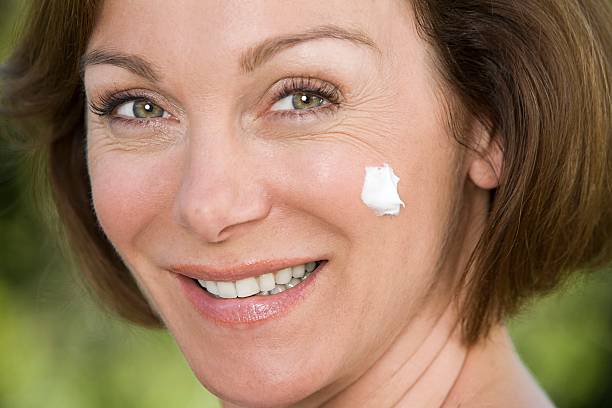
Here’s what happens after menopause that nobody warns you about: your skin’s top layer gets thinner and drier, sure, but the bigger story is happening underneath. The bones in your face are slowly shrinking. The fat pads that used to sit high on your cheeks are losing their firmness and drifting downward. The collagen that acted like an internal scaffolding, holding everything in place, takes a nosedive. In the first five years after menopause, your skin can lose up to thirty percent of its collagen. That’s not a typo. Thirty percent. It’s a structural change, not a surface issue. That’s why all the creams in the world can only do so much if you don’t address the foundation.
Think of your face like a house. The bones are the frame. The fat is the insulation. The collagen is the drywall and plaster. The skin is the paint. Before menopause, everything is snug and supported. After, the frame starts to lose mass, especially around your eye sockets, the middle of your face, and your jaw. Less bone means less to hold the fat in place. So the fat pads drop, creating that hollow look under your eyes and that heaviness around your jowls. Meanwhile, less collagen means the skin itself can’t bounce back like it used to. The result isn’t just wrinkles—it’s a change in the actual architecture of your face.
But here’s the good news: you can do something about it. Not by panicking and throwing money at every anti-aging serum promising to erase time. Instead, think strategically about rebuilding support from the inside out and the outside in.
First, protein. Your body literally cannot make collagen without the building blocks. Most women in their fifties and sixties eat far too little protein—especially high-quality sources like eggs, fish, chicken, and Greek yogurt. You don’t need a powder or a supplement if you’re getting enough, but if you’ve been surviving on salads and toast, your face is showing it. Aim for a palm-sized portion of protein at every meal. It’s the simplest, most direct way to give your body what it needs to hold itself up.
Next, strength training. No, you don’t need to join a scary gym. But weight-bearing exercise does more than build your biceps—it builds your facial bones too. Bones respond to the pull of muscle during exercise, depositing new tissue where pressure is applied. When you lift weights or even do bodyweight squats, your whole skeleton gets a signal to stay strong. That includes the bones of your face. A recent study in the Journal of Bone and Mineral Research found that women who did strength training had denser facial bones than their sedentary peers. You’re not just sculpting your arms—you’re holding up your cheeks.
On the topical side, you need to shift from pure anti-wrinkle thinking to structural support. Look for skincare that boosts collagen, not just hydrates. Retinoids are still the gold standard because they trigger collagen production, but if your skin has gotten drier or more sensitive after menopause, start slowly—twice a week is fine. Pair that with vitamin C in the morning, which helps stabilize collagen and brightens the skin that’s become dull from slower cell turnover. Peptides are also useful here. Think of them as tiny messengers that tell your skin, “Hey, produce more collagen.” They’re not a miracle, but they’re a solid backup.
For the deeper structural changes, in-office treatments can make a real difference, and you don’t have to get a full surgical facelift. Options like microneedling with radiofrequency can jump-start your body’s own collagen production. Ultrasound-based treatments, which you might hear called by various brand names, work even deeper by heating the tissue to tighten and lift. And if you’re open to injectables, strategically placed filler can restore volume that you’ve lost in the cheeks or temples. It’s not about looking “done.” It’s about putting back what menopause took away. Talk to a board-certified dermatologist or plastic surgeon who focuses on natural-looking results.
Also—and this is the part people skip—accept that your face will never look like it did at twenty-five. That’s not a failure. It’s a life well lived. The goal after menopause is not to erase evidence of time. It’s to make sure your outer face matches your inner energy: strong, clear, and confident. You don’t need a time machine. You need a few smart adjustments that respect the structural reality. Your bones are shrinking. Your fat pads are shifting. But you still have enormous control over how gracefully your face carries that change. Give it protein. Give it strength training. Give it collagen-supporting skincare. Give it the same directness you’d give a friend. Then look in the mirror and see the woman who handles real changes with real strategies—not panic, not potions, but practical action.