Notice how you’re reading this right now? Your eyes are slightly narrowed, your lower lids are lifted just a touch. That’s the squint. You don’t feel it because it’s become automatic. Every time you scroll through emails, shop online, or binge a show, you’re tensing the delicate muscles around your eyes. Over time, that tension doesn’t just disappear. It etches. Those tiny lines at the outer corners that beauty tutorials call crow’s feet aren’t only from laughing or smiling. They’re from staring at a screen that’s too bright, text that’s too small, or a posture that puts your face one inch too close to the glow.
Here’s the reality check: the skin around your eyes is the thinnest on your whole body. It also has almost no oil glands, which means it doesn’t self-lubricate like the rest of your face. So it depends on you to treat it with the kind of care you’d give a silk blouse. When you squint all day, you compress that thin skin into small folds. Repetition breaks down collagen, the protein that works like a spring beneath the surface. Lose enough spring, and the lines persist even when your face is completely relaxed.
The good news? You don’t need a $200 cream with rare botanical extracts. You need a few behavior changes first, then a simple product routine to support the area.
Start with your screen. Increase the font size on your phone and computer until you can read without leaning in. Make it comically large. Nobody sees your screen but you. Turn down the brightness to match the ambient light, not to outshine it. Harsh glare forces your pupils to contract and your eye muscles to clamp. A matte screen protector cuts the reflective shine that makes you scrunch subconsciously. If you wear glasses, recheck your prescription. Outdated lenses are a hidden squint trigger. And if you use progressive lenses, ensure they’re fitted correctly – a small temple adjustment can erase the eye strain you’ve learned to ignore.
Take a real break every twenty minutes. You’ve heard of the 20-20-20 rule: look twenty feet away for twenty seconds. That’s not just for fatigue. It lets your periorbital muscles release. Even better, after a long work stretch, close your eyes fully for ten seconds. That brief darkness resets your blink reflex. Here’s a number that will surprise you: you blink about half as often when you’re locked onto a screen. Blinking is your eye’s natural moisturizer; it spreads tears and actually gives a light massage to the outer eye skin. Less blinking means dryer eyes, and dryer eyes make you squint harder to see clearly. It’s a vicious cycle you can interrupt.
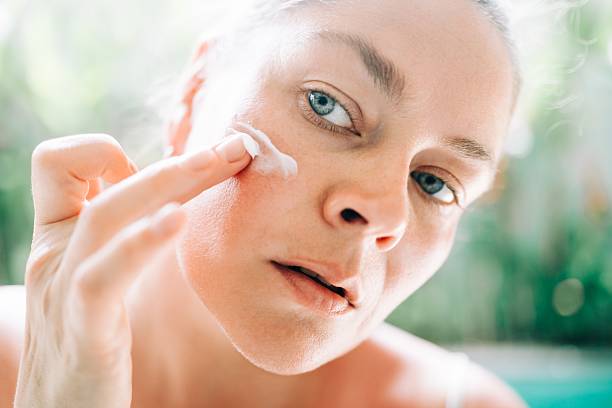
Now let’s talk skincare. Apply any eye cream with your ring finger, because that finger has the weakest pressure, which is exactly what you want. Use a gentle tapping motion – start at the outer corner, move inward along the lower eye bone, and tap until absorbed. Never pull the skin taut when applying anything. Pulling is just another form of folding. If you use actives like vitamin C or retinol at night, be warned: they make skin more photosensitive. Skip sunscreen around your eyes and you’re actively worsening those lines. Choose a mineral sunscreen with zinc oxide. It sits on the surface, reflects light, and won’t sting your eyes the way chemical formulas often do. Apply a small dot to the orbital bone every morning.
Think about your car as well. If you drive toward a low sun in the morning, you squint for the entire commute. Keep a pair of wraparound sunglasses in the driver’s door. Not fashion frames – wraparounds block glare from the sides and keep your eye muscles neutral. Buy three pairs: one for the car, one for your handbag, one on your nightstand for that walk to grab coffee. No excuses, ever.
And then there’s your pillow. Side sleepers, this one’s for you. Pressing your face into a cotton pillowcase folds the skin around your eyes for six to eight hours. That’s a crease that never gets a break. Try sleeping on your back, or switch to a silk or satin pillowcase that lets skin glide instead of bunch. It feels luxurious, but it’s structural, not just indulgent.
Crow’s feet are not the enemy. They’re a map of the expressions you’ve made. Squinting at a glowing rectangle reflects no emotion worth keeping. Stop narrowing your eyes. Increase your fonts, wear your sunnies, tap your creams. Give that thin skin a fighting chance. Your future reflection will thank you.